
The meeting of Black Sea Security network is being conducted
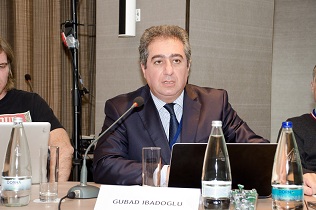 GubadIbadoglu expressed his concern over-expenses allocated for armamentin low-income and high-borrowing countries
The regional meeting of Black Sea Security Network launched on 15th of May in Kishinev, capital of Moldova and implemented with financial and informational support of the Ministry of Foreign Affairs of Finland will be wrapped up today. This meeting was attended about 50 well-known experts from 10 countries. The Republic of Azerbaijan was represented by ArzuAbdullayeva, the head of Baku Bureau of Helsinki Assembly, ZardushtAlizade, the director of Baku Journalist School, including the chairman of Public Initiative Center GubadIbadoglu. On the first day of the meeting, by ArzuAbdullayeva, the head of Baku Bureau of Helsinki Assembly talked about implemented activities in this direction and ZardushtAlizade, the director of Baku Journalist School made presentation on possible resolutions of conflicts across Black Sea region. In addition, the program director of International Crisis Group Sabine Freizer, the head of International Republican Institute IvlianHaindrav, the regional representative of Institute on Crisis Management of Finland MikheilMirziashvili as well as Alexander Skakov, the representative of Russian Academy of Sciences and others delivered speeches during this event.
The chairman of Public Initiative Center GubadIbadoglu made his speech on economy, trade and conflicts related to Black Sea regions. G.Ibadoglu analyzed the economic situations in 10 countries included to Black Sea region. He mentioned that according to the classification of World Bank, Greece and Russia are included to high-income, Turkey, Azerbaijan, Bulgaria and Romania middle-income and Armenia, Georgia, Moldova and Ukraine pertain to low-income countries. He also highlighted that the share of defense expenses within GDP of Russia, Georgia and Armenia is very high compared to other countries in the region. Thus, the share of approved defense budget in the GDP is 5,1 % in Russia, 4,4% in Georgia, and 4,1 % in Armenia for the year of 2013. This relevant figure estimated as 3,4 % in Azerbaijan.
The expert also drew attention on debt crisis and stated that the Russia and Azerbaijan are the only promising countries in this field. The share of foreign debts in GDP of these countries constitute 10,8 and 11,6 % respectively. The relevant indicators were 39,5 % in Armenia, 37,4 % in Ukraine, 36,4 % in Turkey and 32,7 % in Georgia.
G.Ibadoglu brought evidences about the high share of defense expenses within the GDP and he said this trend is going up from year to year. He also stated that this policy impacts negatively to the resolution of conflicts.